Maximum Protection, Maximum Performance – TiStar BMS
BMS Overview
In lithium battery systems, the Battery Management System (BMS) is the core component that ensures safety, stability, and long service life.
All Tistar batteries are equipped with high-performance BMS units that monitor voltage, current, and temperature in real time, and manage the charging and discharging process, providing multiple layers of protection to ensure stable and reliable performance in all applications.
Voltage Management
- Low Voltage Protection
Prevents over-discharge, protecting battery life and ensuring stable operation. When a single cell voltage drops below 2.7 ±0.05 V, the BMS automatically cuts off discharge. Discharge resumes once the voltage recovers to 3.0 ±0.05 V.
Recovery Methods
Normal Charging: Use a compatible lithium battery charger. As the cell voltage gradually rises to the recovery threshold, the BMS automatically releases protection.
Trickle Charging: Charges the battery with a very small current, typically 0.01C ~ 0.1C of the capacity. Eg: 100Ah → 1A–10A.
Purpose: Slow but gentle charging, avoids current shocks, and safely wakes up low-voltage cells.
👉 If recovery still fails, please contact us for professional service.
⚠Do not charge under low-temperature conditions. Battery must be warmed to ≥5°C first.
⚠Do not force discharge in low-voltage protection mode or use unsuitable power sources.
⚠Do not leave battery in low-voltage protection for extended periods. Recharge promptly to preserve service life.
- High Voltage Protection
Prevents overcharge, ensuring safety and extending cycle life. When a single cell exceeds 3.65 ±0.05 V, the BMS stops charging. Charging resumes once the voltage falls to 3.34 V.
Recovery Methods
- Stop Charging: Disconnect the charger. Voltage will naturally drop.
- Light Load Discharge: Apply small safe discharge load to accelerate recovery.
⚠Do not use chargers with excessively high output voltage.
⚠Do not force charging beyond safe voltage limit.
⚠Do not leave battery in high-voltage protection for long periods.
Current Management
- Discharge Overcurrent Protection
Limits excessive discharge currents, preventing damage to the battery and connected equipment.
| Capacity | 100Ah | 156Ah | 206Ah | 314Ah |
|---|---|---|---|---|
| Overcurrent Protection 1 | 160A | 210A ±2% | 210A ±2% | 270A |
| Delay Time | 3s | 60s | 60s | 320ms |
| Reset Condition | Remove load | |||
- Charge Overcurrent Protection
Prevents excessive charging current to ensure safety.
| Capacity | 100Ah | 156Ah | 206Ah | 314Ah |
|---|---|---|---|---|
| Protection Current | 160A | 210A ±2% | 210A ±2% | 270A ±2% |
| Delay Time | 3s | 10s | 10s | 10s |
| Reset Condition | Self-release after 1 min | |||
Temperature Management
- Low-Temperature Protection
Prevents charging or discharging below safe levels. Charging disabled ≤0°C, resumes ≥5°C. Discharging disabled ≤-20°C, resumes ≥-15°C.
Temperature Recovery Guidelines: Warm battery by placing in warmer environment, light discharge, or low-power heating pad.
⚠ Never use high-power heat guns, open flames, or hot water for rapid heating. Do not charge while heating.
⚠ Never attempt charging while the battery is below safe temperatures.
- High-Temperature Protection
Stops charging/discharging above safe limits. Charging disabled ≥60°C, resumes ≤50°C. Discharging disabled ≥65°C, resumes ≤55°C. Cooling methods: move to ventilated/shaded area, pause operation, use fans/AC if necessary.
⚠ Never cool rapidly with cold water, ice, or refrigeration, as this may cause condensation or internal damage.
⚠ Do not continue charging/discharging while the battery remains above safe temperatures.
Safety Protections
Short-Circuit Protection
Instantly detects and cuts off short circuits to protect the battery and equipment.
| Capacity | 100Ah | 156Ah | 206Ah | 314Ah |
|---|---|---|---|---|
| Short-Circuit Current | 800A ±160A | 1240A ±400A | 1240A ±400A | 1560A ±400A |
| Reset Condition | Remove load | |||
Reverse Current Protection
Blocks reverse current from external loads or other batteries, protecting both battery and upstream circuits.
Balancing Management
The BMS balances voltage differences between cells during charging, ensuring cell consistency, reducing capacity loss, and improving stability and cycle life under high discharge rates.
Communication & Intelligence
Bluetooth App / Display Monitoring: real-time monitoring of voltage, current, temperature, SOC, and balancing status.
200A BMS Highlight
Designed for multi-battery parallel systems, using advanced ICs and AI algorithms to intelligently distribute current across packs, preventing overload, overcurrent, and overvoltage caused by pack-to-pack variations.
Conclusion
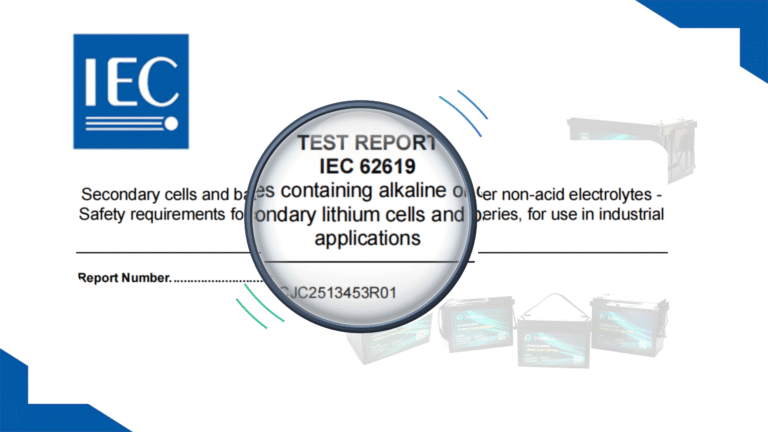
The Tistar BMS series fully complies with IEC 62619 standards. Through precise protection mechanisms, balancing management, and temperature control, it ensures optimal performance across different power levels.
It delivers comprehensive protection and intelligent management for RVs, boats, and off-grid systems, ensuring reliability under varying loads and environmental conditions, while effectively extending battery lifespan.